
Leave Us Message Author:Mingtai Aluminum
In the aluminum foil processing industry, 20 micron aluminum foil jumbo roll represents a distinctive specification.
It is thinner than household foil yet thicker than ultra-thin capacitor foil. This very reason makes this specification widely used in industrial manufacturing.
This article covers the core parameters, primary applications, and key considerations when sourcing this product.
When selecting this gauge, three key indicators deserve close attention.
At 20 microns, even slight deviations can cause problems downstream:
- Tension fluctuations during slitting, leading to breaks
- Inconsistent coating weight, affecting cost
- Bubbling or delamination after lamination
Professional base material suppliers control thickness tolerance within ±4% to ±5%. This range ensures stable downstream processing.
Different alloys serve different purposes:
Alloy | Characteristics | Common Temper | Primary Use |
1235, 8011 | High purity, good elongation | O (soft) | Packaging lamination, laminating materials |
3003 | High strength, good rigidity | H18 (hard) | HVAC heat exchangers, automotive radiators |
Physical parameters directly impact production efficiency:
- Width: 200mm – 1600mm, customizable to slitting equipment
- Core diameter: Typically 76mm or 150mm
- Outer diameter: Depends on roll weight and width
- Joints: Fewer joints mean fewer roll changes and less downtime
Among these, the number of joints is often overlooked but significantly affects efficiency.
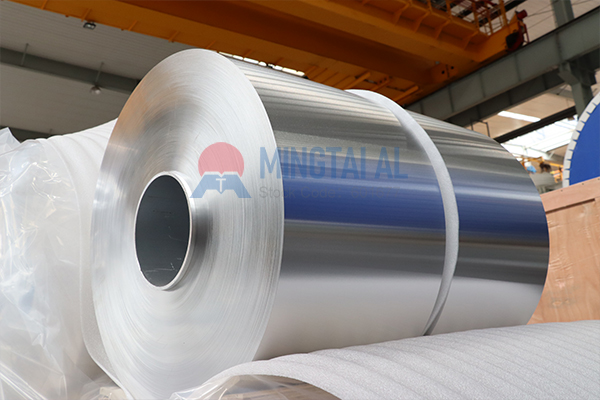
This gauge serves as a base material across several industries.
Flexible Packaging
As a barrier layer in composite materials, it is widely used in food and pharmaceutical packaging (such as PTP foil). Its role is straightforward—blocking oxygen, moisture, and light to extend shelf life.
For this application, surface wettability and cleanliness are critical. These two factors determine bond strength when laminating with PE, PET, or other materials.
Industrial Manufacturing
In HVAC heat exchangers and automotive radiators, it is often used in hard temper (H18). These applications demand good flatness. Poor flatness leads to wrinkles during stamping, directly reducing yield.
Structural Materials
Aluminum honeycomb core is another important application. Aerospace, rail transit, and high-end construction all rely on it. Here, formability and adhesive bonding strength are key.
Electronics
It is also used in some medium to high voltage capacitors and shielding materials. These applications prioritize material purity and pinhole control.
As an integrated mill, we recommend evaluating suppliers from these angles.
In-House Production Capability
- Does the supplier have a complete production chain from molten aluminum to foil rolling?
- A full production chain means more stable supply and better quality control
Flatness Control
- Are the jumbo rolls flat? Any wavy edges or warping?
- Professional suppliers use shape measurement systems to monitor flatness throughout the roll
Cleanliness
- Rolling oil cleanliness directly affects surface quality
- Residual oil stains can affect downstream printing or lamination
Supply Reliability
- Can they meet customized width requirements?
- Is lead time consistent?
Some assume: "The thinner the foil, the higher the technical difficulty. 20 micron is easy to make."
That is not the case.
This gauge sits at a tipping point—too thin and it tears easily, too thick and it loses cost efficiency. Producing it in jumbo rolls while maintaining low break rates, consistent mechanical properties, and clean surfaces places high demands on equipment and process control.
Q: What alloys are commonly used?
A: Packaging applications typically use 1235 or 8011 alloys. Industrial applications often use 3003 or 3102 alloys. The choice depends on forming requirements and strength needs.
Q: How to ensure consistent slitting without breaks?
A: Uniform tensile strength and good flatness are key. When these are well controlled, downstream processing runs smoothly.
Q: Can width be customized?
A: Yes. Standard widths range from 200mm to 1600mm, and integrated mills typically support customization based on your slitting equipment.
Q: For packaging applications, what matters most?
A: Surface wettability and cleanliness. These directly determine lamination bond strength.
If you are looking for a reliable supplier of 20 micron aluminum foil jumbo roll, Mingtai Aluminum offers professionally produced base material with precise thickness and consistent flatness, backed by an integrated production chain and strict quality control.
Hot Sale Products
Aluminum foil for takeout containers Aluminum foil for cosmetic bottle caps Lidding aluminum foil Aluminum foil for sealing gasket Cable Aluminum Foil 6061 aluminum foil Milk Powder Can Lid Aluminum Foil
Solutions
Aluminum foil for vaccine packaging buyer’s checklist Reliable Aluminum Foil for Lithium Battery Packaging How to Choose Aluminum Foil for Medicine Blister Packs How to Get a Fair 8011 Aluminum Foil Price Quote Get Specs & Solutions for Aluminum Semi Rigid Container Foil Aluminum Foil for Cold Chain: Insulation and Barrier Tips Purchasing Food Safe Aluminum Foil Jumbo Rolls? 5 Key Factors for You Top Questions to Ask an Aluminum Foil Supplier
Quick Contact
Copyright © 2022 Mingtai Aluminum All Rights Reserved.


